Protected by Copyscape Web Copyright Protection Software India Flag
India Flag by Expedia.com.au
Showing posts with label Burma. Show all posts

Thursday, April 11, 2019

Flags in Grief: Flags at Half-Mast, Flag Draped Caskets and Funeral Cortege


Flags in Grief: 
Flags at Half-Mast, Flag draped Caskets & Funeral Cortege.

Flag at Half-Mast or Half-Staff
The origin of the custom of lowering a flag at half-mast’ to indicate mourning is a little unclear. Its observance appears to date back to the sixteenth century, as a custom of the sea, which has spread to the land and became universal. A sailors superstition perhaps, the flag of mourning is flown at half-mast to leave space for death’s imaginary flag to be flown above it.  It is a sign that death has conquered, and that the invisible flag of the death is flying over the lowered colours of the vanquished. The half-staff tradition has developed important meaning over time.

The earliest record we have of the lowering of a flag to signify a death was an occasion in 1612, when the Master of the 'Hearts Ease', William Hall, was murdered by Eskimos while taking part in an expedition in search of the North West Passage. On rejoining her consort, the vessel's flag was flown trailing over the stern as a mark of mourning. On her return to London, the 'Hearts Ease' again flew her flag over the stern and it was recognised as an appropriate gesture of mourning.
World's First stamps showing a Flag at Half-Mast: Burma 1948
     Issued to commemorate the anniversary of the assassination of Burma's leaders      in the fight for independence.
In the United States, the earliest reference to half-staff, or half-mast, occurred in 1799. All Navy vessels were ordered by the Navy Department to fly the American flag at half-mast when George Washington died. 
Photo Courtesy: Oded Deutch, Israel
A further sign of mourning is to attach black ribbons tied as a bow to the top of the flag. If mourning is to be observed in a parade or procession, where a flag is carried, two streamers of black crepe are attached to the spearhead, allowing the streamers to fall naturally. The use of black crepe in such a manner shall only be by an order of the government.

Flag Code of India stipulatesHalf-mast is meant hauling down the Flag to one-half the distance between the top and guy-line and in absence of the guy-line, half of the staff’. To achieve this position the flag should be first hoisted to the peak for an instant and then slowly lowered to the half-mast position, but before lowering the Flag for the day, it shall be raised again to the peak. 

 Here is a selection of Postage Stamps showing Flags at Half-Mast from across the World.


Flag Draped Caskets
At the time of mourning Flags are draped over the coffins of national heroes. The association of flags with funerals began centuries ago when caskets of Royalty was decorated with symbols of authority.
Guarding Nelson’s Body

Lord Nelson (1758 – 1805) English naval commander who died during the Battle of Trafalgar (1805) in the Napoleonic Wars. 
Perhaps, World's First Stamp Depicting Funeral Scene is on Atahualpa: Peru 1918
Funeral Scene, Timisoara Uprising, Romania 1989.
In the post-independence India, the first National State Mourning was observed when Mahatma Gandhi, the father of the nation died on January 30, 1948.


New Delhi 31 the most immediate the most immediate His Highness Nawab Balasinor. Government of India regret Mahatma Gandhi was victim of shooting outrage. Gandhiji expired yesterday evening.  Cremation will take place Saturday 4 P.M. Prime minister has broadcast Saturday 31st be observed as day of fasting and prayer suggest offices should close entirely and flags half mast from sunrise =


Funeral Cortege

“cortege” is the procession when the coffin is transported to or from the ceremony - and this is done “in style”, with a elegant hearse (car or horse-wagon) and some cars with the family and guests following (or the guests might also be walking by foot).
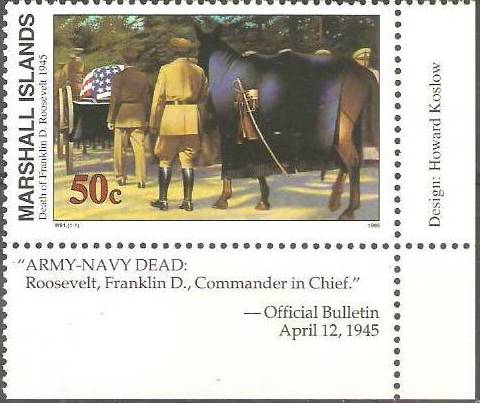
In State funerals in the United States, a Caisson (a two-wheeled ammunition wagon), is used in place of a gun-carriage.

Funéral of Charles de Gaulle; November 1, 1970


Tuesday, August 10, 2010

Birds on Flags, Part - II

Continued from previous Post.
 We have seen Burma (Myanmar) had a flag which showed "Peacock" emblem. The Imperial Mauryas (3rd. century BC) of India had the "Peacock" as their emblem as it was their totemistic bird. Sri Lanka on the other hand also issued a set of four stamps showing Ancient Flags of Sri Lanka. One of the stamp shows "Peacock Flag" of the Walapane Diswa dynasty. Here the Peacock can be seen holding a snake in its beak.
Modern Mexico also adopted the ancient Aztec symbol of an Eagle holding a snake in its beak standing on a nopal cactus. The striking similarity of the themes of both the ancient Sri Lanka's and modern Mexican flags are baffling.
  
 The Bald Eagle became the National symbol of the USA in 1782 when the great seal of the US was adopted (first conceived by Charles Thomson). The Bald Eagle is the single most prolific symbol in America, it represents unlimited Freedom. There are several Federal/State agencies in the US who have placed Bald Eagle in their flags.


 State flags of the USA having Bald-eagle emblem.
Bald-headed American Eagle on the US Coast Guard Ensign.

Pelican is the state emblem of Louisiana (US). The Pelican in the flag is nourishing its young on blood from its own breast, signifying self sacrifice.
  .

In the third quarter of the shield emblazoned on the flag of Fiji is a "Dove with a sprig of olive" in its beak.

Personal flag of HM Queen Elizabeth II  for use in Australia.
The "White Backed Piping Shrike" at the bottom left quarter representing South Australia, while the "Black Swan" in the next represent Western Australia. 
********* 
Next Post > Animals on Flags


Thursday, August 5, 2010

Birds on Flags

Most of my previous posts were devoted to the history and evolution of the Indian National flag under the caption "Quest For a National Flag for India". Since, the series has been completed for the time being, I shall now concentrate on other topics and symbolisms concerning to the National flags of the World.
Most  'National Flags' have symbols and they all have special significance with respect to their country. Symbols on Flags are explicit outward expressions of how the country looks at itself. Let us now glance over such 'Symbols on Flags' as depicted on postage stamps.  

BIRDS ON FLAGS

Many countries have placed "Birds" on their National Insignia and flags. Because of the Birds connection to the sky, they have been thought of as a supernatural link between the heavens and the earth. The birds represent a passage between the physical world and spiritual worlds. Birds in flight represent freedom.


The “Double-headed Eagle” devise is inherited from the Byzantine empire. The head on the left (West) symbolizes Rome, the head on the right (East) symbolizes Constantinople. It became widely associated with the Holy Roman Empire. Several Eastern European nations adopted it from the Byzantines and continue to use it as their national symbol to this day, the most prominent being Albania, Austria, Germany, Russia, erstwhile Epirus India’s Mysore State also had a double-headed Eagle the “Gandaberunda” as the royal symbol.


 The legendary Gandaberunda possessing two heads facing away from the other was the emblem of the Mysore rulers of the Wadeyar Dynasty.
Indian Navy adopted the Gandaberunda as the crest of the ship 'INS Mysore'.

'Qureish falcon’ of the Egyptian flag was replaced by the Eagle of Saladin’ bearing on its breast a shield with the national colours in 1984. (Eagle - the emblem of Saladin - a 12th. century Sultan and opponent of the Crusaders)

The flag of Mexico is an Eagle holding a snake in its beak and standing on a prickly pear. The serpent and the Eagle refer to the legendary foundation of Tenochtitlan (Mexico) by the Aztecs combining the two cosmic forces: that of the sun in the eagle and those of the earth in the serpent.


The Condor – a local bird of the Equatorian Andes- opens its wings and with its majesty and energy symbolizes the Fatherland in its effort of self improvement and progress.

The Steppe Eagle or Berkut (Aquila Nipalensis) is a bird of prey. The Steppe Eagle is the national bird of Kazakhstan and can be seen on its National Flag.
The Goshawk (Acor in Portuguese) refers to the Islands of Azores
  

The Sisserou Parrot (Amazona imperalis) “The Pride of Dominica”, is the National Bird of Dominica. The parrot figures prominently on the Coat of Arms, the National Flag, The Public Seal, The Mace of the House of Assembly and Dominica’s Honours for Meritorious Service to the Country. The Sisserou Parrot is protected and is found only in Dominica.In 1988 the parrot, which was originally facing right was turned to face the left of the flag.

Burma(Myanmar) had once the "Peacock" as their national emblem. According to believes the Peacock heralds spring, birth, new growth, longevity, and love. (Stamps at the top were issued by Burma Independence Army during Japanese Occupation in1943).

The soapstone bird featured on the flag represents a statuette of a bird found at the ruins of Great Zimbabwe. The bird symbolizes the history of Zimbabwe and now is a national symbol. The flag was adopted on April 18, 1980. Zimbabwe gained independence from Britain as Southern Rhodesia in 1965 and then gained independence from Rhodesia as Zimbabwe in 1980.
 The Resplendent Quetzal (Paramocrus Mocinno), the brilliant bird found in the cloud forests of Central America, was sacred to the Mayans and figures prominently in their artwork and legends. Today the Quetzal (also spelled Quetzel and Quesal) is the national bird of Guatemala, and name to the Guatemalan currency.
 The Flag of Kiribati has on the upper half a gold frigate bird (Fregata minor, in Kiribati te eitei) flying over a gold rising sun (otintaai). The frigate bird (also called 'Man-of-War' birds or Pirate birds) symbolizes command of the sea, power, freedom and Kiribati cultural dance patterns. Kiribati's flag is an armorial banner, a flag having a design corresponding exactly to that of the shield in the coat of arms. The coat of arms dates back to May 1937 when it was granted to the Gilbert and Ellice Islands, as Kiribati and Tuvalu were then known. The shield was incorporated into the center of the fly of a British Blue Ensign as the state ensign of the colony.

The birds-of-paradise are members of the family Paradisaeidae of the order Passeriformes. The majority of species in this family are found on the island of New Guinea and its satellites. The members of this family are perhaps best known for the plumage of the males of most species, in particular highly elongated and elaborate feathers extending from the beak, wings or head. The family is of cultural importance to the inhabitants of Papua New Guinea.

African Balearic Crested Crane (Balearica regulorum) is a bird in the crane family Gruidae. This bird does not migrate. There are two subspecies. The East African Crested Crane is the national bird of Uganda.
*********