Fierce Animals on National flags signify “A country’s strength, its priority on defence and on occasions generosity too”.
Amongst the animals depicted on flags, perhaps, the Lion is the most widely used animal symbol on flags. The Lion is regarded as the symbol of Authority & Command, Power & Dignity, Justice & Wisdom, Ferocity & Courage, and finally The Lion is also regarded as the king of beasts.

The flag of the Repùblica
Vèneta or Repùblica de Venesia (Republic of Venice)
- a state originating from the city of Venice in North-eastern Italy. It
existed for over a millennium, from the late 7th century until 1797. It was
formally known as the Most Serene Republic of Venice (Serenìsima Repùblica Vèneta)
and is often referred to as La Serenissima.
The winged
Lion of St. Mark, which had appeared on the Republic's
flag and coat of arms, is still featured in the red-yellow flag of the city of
Venice (which has six tails, one for each
sestier of
the city), in the coat of arms of the city and in the yellow-red-blue flag of
Veneto (which has
seven tails representing the seven provinces of the region).
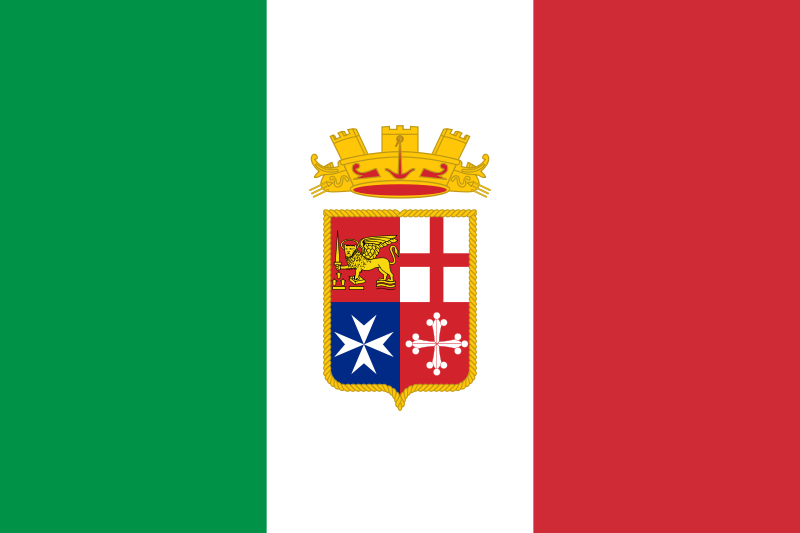
The winged lion also appears in the
naval
ensign of the Italian Republic, alongside the coat of arms of three other
medieval Italian maritime republics (
Genoa,
Pisa
and
Amalfi), as well as the
Golden Lion,
awarded at the
Venice Film Festival, and in the insignia of
the
Assicurazioni Generali insurance company.
St Mark, represented as a lion, is a typical Christian iconography
derived from the prophetic visions contained in the verse of the
Apocalypse of St John
4: 7. The lion is one of the four living creatures described in the
book as a place around the throne of the Almighty and they are chosen as
symbols of the
four evangelists. These "beings" were previously described by the prophet
Ezekiel.(Source: Wikipedia).
Lion of Babylon on the Iranian (formerly Persia) Flag. It is claimed that the Lion and Sun Emblem has 8000 years old roots dating back to the very first Persian Civilization of Shush. According to legends, The lion was the symbol of the goddess Ishtar.
Lion of Judah on former Ethiopian (Abyssinia) Flag which was also the symbol of Emperor Haile Selassie .

+of+Page+42.jpg)
Sri Lanka (formerly Ceylon) always placed the lion on her flags
adopted from Sinhala Rajakiva Dhajya of the last king of Kandi.
Lion on the Sri Lanka’s flag dates from 6th. century B.C.
India's National emblem, the Sarnath Lion -capital, a great master-piece of 3rd century BC plastic art, there are four lions mounted back to back .
(Only three lions are visible, the fourth being hidden from view).The frieze of the abacus adorned with relief sculptures of an elephant, a galloping horse, a bull and a lion. The Lion stands for Sakyasingha, the great roar of the lion heard when Buddha turned the "Wheel of Law" to preach to the world the great wisdom that he had dawned on him under the Bodhi tree.
The lion, with such repute of its noble nature and having the position and title of king of the beasts, is one of the most common heraldic symbols in Europe.
Hunydi family flag (15th. century), Hungary.
The Red Lion in white background, symbolising León
On occasion of the commemoration of the 1100 Anniversary of the Foundation of the Kingdom of León, issued within the Historic Events series of Spain, a souvenir sheet was launched illustrated with a map of the Iberian Peninsula from 910 and the borders of the kingdom of Leon. At the front appears a stamp in the shape of the banner of the crown of León with a passant lion.
Bulgaria places a golden lion rampant on the top white stripe
Paraguay's flag has two different emblems on the obverse and reverse sides. On the reverse side of the Paraguay seal shows the lion on the sea guarding the Phrygian Cap symbolizes the defence of liberty.
+of+Picture+018.jpg) Several former British Colonies placed the British Lion (taken from the British Coat-of-Arms) on their flags.
In 1929 H L Richardson of Wellington was appointed to design a new set of Duty (Revenue) stamps of New Zealand.
His design incorporated the New Zealand's Coat of Arms. However, Richardson, depicted his own interpretation of the subject, which varied considerably from the version authorised by Royal Warrant in 1911. An error was also made in the design whereby the New Zealand flag is depicted instead of the Union Jack.
The British Lion and Chinese Dragon could be seen as the flanking supporters on the coat of arms emblazoned on the colonial Ensign of Hong Kong .
The Dragon on Bhutan’s flag honours the people’s name of the country Druk-Yul
(The land of the Thunder Dragon) .The flag is based upon the tradition of the Drupka lineage of Tibetan Buddhism.
The first flag was made by Mayom Choying Wangpo Dorgi and was introduced in 1949 during the signing of the Indo-Bhutanese Treaty.
The flag went many changes. The present flag was standardized in 1972. The wingless white dragon, in its claws the Dragon grasps jewels, standing for national wealth and the embrangling mouth of the Dragon represents the strength of the male and female deities, protecting the country.
The Red Dragon “Y Ddraig Goch”
Adorns Wales Flag. It was probably first used in 1401 by Owen Glendower.
Tiger is another fierce animal and appeared on many flags representing powerful energy. In many Asian countries, the Tiger is considered the 'king of all beasts' (not the lion).
The ‘Springing tiger’ on the flag of the Indian National Army (INA) reflects the strength of the Indian people and their will to fight for freedom and for the country’s defence.
The above never issued stamps were officially printed in 1943 at Reichsdruckerei, Berlin for the Nationales Indien (Indische Legion).
(Note; These stamps were prepared for use in Free India but
the plan failed due to set back of Azad Hind Army's campaign in the War)
Several former British Colonies placed the British Lion (taken from the British Coat-of-Arms) on their flags.
In 1929 H L Richardson of Wellington was appointed to design a new set of Duty (Revenue) stamps of New Zealand.
His design incorporated the New Zealand's Coat of Arms. However, Richardson, depicted his own interpretation of the subject, which varied considerably from the version authorised by Royal Warrant in 1911. An error was also made in the design whereby the New Zealand flag is depicted instead of the Union Jack.
The British Lion and Chinese Dragon could be seen as the flanking supporters on the coat of arms emblazoned on the colonial Ensign of Hong Kong .
The Dragon on Bhutan’s flag honours the people’s name of the country Druk-Yul
(The land of the Thunder Dragon) .The flag is based upon the tradition of the Drupka lineage of Tibetan Buddhism.
The first flag was made by Mayom Choying Wangpo Dorgi and was introduced in 1949 during the signing of the Indo-Bhutanese Treaty.
The flag went many changes. The present flag was standardized in 1972. The wingless white dragon, in its claws the Dragon grasps jewels, standing for national wealth and the embrangling mouth of the Dragon represents the strength of the male and female deities, protecting the country.
The Red Dragon “Y Ddraig Goch”
Adorns Wales Flag. It was probably first used in 1401 by Owen Glendower.
Tiger is another fierce animal and appeared on many flags representing powerful energy. In many Asian countries, the Tiger is considered the 'king of all beasts' (not the lion).
The ‘Springing tiger’ on the flag of the Indian National Army (INA) reflects the strength of the Indian people and their will to fight for freedom and for the country’s defence.
The above never issued stamps were officially printed in 1943 at Reichsdruckerei, Berlin for the Nationales Indien (Indische Legion).
(Note; These stamps were prepared for use in Free India but
the plan failed due to set back of Azad Hind Army's campaign in the War)
An Indian official stamp
issued in 1968 to commemorate
25th. Anniversary of INA.
The flag of the
federated Malaya States (1905-1946) represented the union of the four
Malay states of Selangor, Perak, Negeri Sembilan and Pahang
in a federation as a protectorate under the British Crown. The flag was
striped white over red over yellow over black. In the centre was a leaping Malayan
tiger (Harimau Malaya). The coat-of-arms had two rampant tigers supporting the shield.
|
Three Headed Elephant was the emblem
of the erstwhile, Kingdom of Laos, the land of the Million Elephants (Muong Lan Xan Hom Khao)
The black and white stripes of the flag symbolize the racial harmony of the Botswana’s Tswana people (formerly, British protectorate of Bechuanaland), as well as the pluralist nature of the society. The stripes are inspired by the ‘Zebra’, the national animal of Botswana.
The leopard's face on Bophuthatswana flag is symbolic of the authority necessary to lead the people to the development of their potential.
Leopards are traditional symbols of authority for the Tswana people.
The flag was taken into use on 19 April 1973 after the homeland achieved internal
self-government on 01 June 1972. This flag is no longer in use.
Bophuthatswana was one of the "independent" homelands having been granted independence by South Africa in 1977. All the former South African Homelands/Bantustans ceased to exist as political entities in 1994 Bophuthatswana have been reincorporated into South Africa.
 The boar’s tusk in the black triangle of Vanuatu (formerly, New Hebrides) flag, symbolic of wealth and prosperity
The California's state flag is based on a design dating from 1846, when California settlers declared independence from Mexico. The Grizzly Bear symbolizes strength. Snapshot art depicts a coastal area in central California
Historic Bear Flag raised at Sonora in 1846, by a group of American settlers in revolt against Mexican rule. The flag was designed by William Todd. The star imitated the 'Lone Star' of Texas.
The boar’s tusk in the black triangle of Vanuatu (formerly, New Hebrides) flag, symbolic of wealth and prosperity
The California's state flag is based on a design dating from 1846, when California settlers declared independence from Mexico. The Grizzly Bear symbolizes strength. Snapshot art depicts a coastal area in central California
Historic Bear Flag raised at Sonora in 1846, by a group of American settlers in revolt against Mexican rule. The flag was designed by William Todd. The star imitated the 'Lone Star' of Texas. [Source: California Blue Book.]
The bear on the current flag of California was modeled on the last wild Californian grizzly bear in captivity. The bear, named "Monarch", was captured in 1889. The bear was subsequently moved to Woodwards Gardens in San Francisco, and then to the zoo at Golden Gate Park. After the bear's death in 1911, it was mounted and preserved at the Academy of Sciences at Golden Gate Park
An alpaca standing next to a tree and some wheat. The alpaca stands on a plain that contrasts with the mountain. The alpaca is the national animal of Bolivia, and the items next to it are symbolic of the resources of the nation. Alpaca (Vicugna pacos) is a domesticated species of South American Camelid. It resembles a small llama in appearance.
***********




.svg.png)

.svg.png)


bop-1.gif)


+of+Page+41.jpg)


col.gif)

