Protected by Copyscape Web Copyright Protection Software India Flag
India Flag by Expedia.com.au
Showing posts with label Romania. Show all posts

Thursday, April 11, 2019

Flags in Grief: Flags at Half-Mast, Flag Draped Caskets and Funeral Cortege


Flags in Grief: 
Flags at Half-Mast, Flag draped Caskets & Funeral Cortege.

Flag at Half-Mast or Half-Staff
The origin of the custom of lowering a flag at half-mast’ to indicate mourning is a little unclear. Its observance appears to date back to the sixteenth century, as a custom of the sea, which has spread to the land and became universal. A sailors superstition perhaps, the flag of mourning is flown at half-mast to leave space for death’s imaginary flag to be flown above it.  It is a sign that death has conquered, and that the invisible flag of the death is flying over the lowered colours of the vanquished. The half-staff tradition has developed important meaning over time.

The earliest record we have of the lowering of a flag to signify a death was an occasion in 1612, when the Master of the 'Hearts Ease', William Hall, was murdered by Eskimos while taking part in an expedition in search of the North West Passage. On rejoining her consort, the vessel's flag was flown trailing over the stern as a mark of mourning. On her return to London, the 'Hearts Ease' again flew her flag over the stern and it was recognised as an appropriate gesture of mourning.
World's First stamps showing a Flag at Half-Mast: Burma 1948
     Issued to commemorate the anniversary of the assassination of Burma's leaders      in the fight for independence.
In the United States, the earliest reference to half-staff, or half-mast, occurred in 1799. All Navy vessels were ordered by the Navy Department to fly the American flag at half-mast when George Washington died. 
Photo Courtesy: Oded Deutch, Israel
A further sign of mourning is to attach black ribbons tied as a bow to the top of the flag. If mourning is to be observed in a parade or procession, where a flag is carried, two streamers of black crepe are attached to the spearhead, allowing the streamers to fall naturally. The use of black crepe in such a manner shall only be by an order of the government.

Flag Code of India stipulatesHalf-mast is meant hauling down the Flag to one-half the distance between the top and guy-line and in absence of the guy-line, half of the staff’. To achieve this position the flag should be first hoisted to the peak for an instant and then slowly lowered to the half-mast position, but before lowering the Flag for the day, it shall be raised again to the peak. 

 Here is a selection of Postage Stamps showing Flags at Half-Mast from across the World.


Flag Draped Caskets
At the time of mourning Flags are draped over the coffins of national heroes. The association of flags with funerals began centuries ago when caskets of Royalty was decorated with symbols of authority.
Guarding Nelson’s Body

Lord Nelson (1758 – 1805) English naval commander who died during the Battle of Trafalgar (1805) in the Napoleonic Wars. 
Perhaps, World's First Stamp Depicting Funeral Scene is on Atahualpa: Peru 1918
Funeral Scene, Timisoara Uprising, Romania 1989.
In the post-independence India, the first National State Mourning was observed when Mahatma Gandhi, the father of the nation died on January 30, 1948.


New Delhi 31 the most immediate the most immediate His Highness Nawab Balasinor. Government of India regret Mahatma Gandhi was victim of shooting outrage. Gandhiji expired yesterday evening.  Cremation will take place Saturday 4 P.M. Prime minister has broadcast Saturday 31st be observed as day of fasting and prayer suggest offices should close entirely and flags half mast from sunrise =


Funeral Cortege

“cortege” is the procession when the coffin is transported to or from the ceremony - and this is done “in style”, with a elegant hearse (car or horse-wagon) and some cars with the family and guests following (or the guests might also be walking by foot).
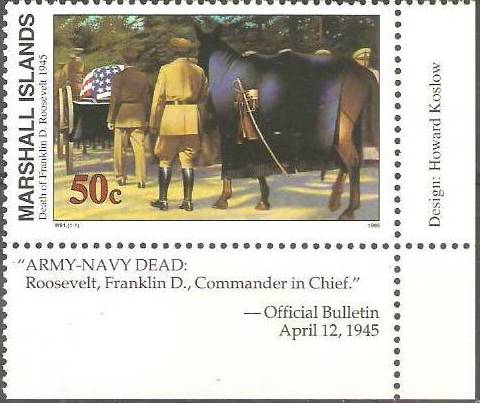
In State funerals in the United States, a Caisson (a two-wheeled ammunition wagon), is used in place of a gun-carriage.

Funéral of Charles de Gaulle; November 1, 1970


Wednesday, November 24, 2010

FLAGS in National Anthems and Patriotic Songs, Part- VII


Palestine
Fida'I  (Revolutionist‎) is the “Anthem of the Palestinian revolution". It was adopted in 1996. Written by Said Al Muzayin (Aka Fata Al Thawra), and its music was composed by Egyptian maestro Ali Ismael. The song commences with the words:  Biladi Biladi (My country, my country) and the last stanza goes with:

“By the oath under the shade of the flag
By my land and nation, and the fire of pain
I will live as a Revolutionist*, I will remain a Revolutionist,
I will end as a Revolutionist - until my country returns”.

Philippines

The Philippine National Anthem lyrics has three versions- "Lupang Hinirang" in Tagalog language (1948) penned by F
elipe Padilla de Leon
The anthem music was composed by Julian Felipe in 1898. The stamps above features Julian Felipe, the anthem composer, with Jose Palma.

 The anthem in Spanish version "Filipinas" was written by Jose Palma in 1899,  

  "Philippine Hymn" the anthem in English version (1938) was written by Camilo Osias.
Presently, only the anthem in Tagalog version is used throughout Philippines.
The first and second verses and the chorus of the Lupang Hinirang allude to the light of the sun and stars in the flag; the fourth verse states “Thy banner, dear to all our hearts, its sun and stars alight, O never shall its shinning field be dimmed by Tyrant’s might”.

 
Portugal
A Portuguesa  is the national anthem of Portugal. Composed by Alfredo Keil  and written by Henrique Lopes de Mendonca during the resurgent nationalist movement ignited by the 1890British ultimatum to Portugal concerning its African colonies. It was adopted as the national anthem of the newborn Portiguse Republic in 1911, replacing O Hino da Carta  the anthem of the deposed  monarchy.


 Portugal celebrated the 100th anniversary of the first performance of its national anthem in 1990.

The anthem proclaims;
“Unfurl the unconquering flag in the bright light of your sky! Cry out to all Europe and the whole world that Portugal has not perished”.


Romania
Trei culori (Three colours) was the national anthem of Romania from 1977 until 1989. Since the anti-communist Revolution of 1989 it has been replaced by Deşteaptă-te, Române! (1989-present). Trei culori  was written by Ciprian Porumbescu, as the name suggests the anthem had a  direct reference to the Romanian tricoloured national flag. 

The song had the following wordings (variously translated);

Three colours I know in the world
And I hold them like a holy jewel
They are colours with an ancient fame
Reminders of a brave nation.
As long as in the sky and in the world
There will be these three colours
We'll have a glorious name
And a glorious future.
Red is the bravery's fire
Sacrifices that won't ever be lost
Yellow, the plain's gold
And blue is our sky.
Envelope with the score of Porumbescu's "Trei Culori" (in use-1977-1990) issued in 1977.
Even Te Slăvim Românie (We glorify thee, Romania) which was the national anthem during the period between 1953 and 1977 mentioned the Flag. 
São Tomé and Príncipe
“Independência Total” is the national anthem of São Tomé and Príncipe. The anthem, adopted in 1975, was written by Alda Neves da Graça do Espírito Santo and composed by Manuel dos Santos Barreto de Sousa e Almeida.


In the crusade of the African peoples,
Raising the national flag.
Voice of the people, present, present and united.

Saudi Arabia
The “Al- Salaam al-Mamlaki al- Saud”the Royal Salute of Saudi Arabia  was adopted in 1950 and then again in 1984 with a change in lyrics. The original lyrics (1950) were written by Mohammed Talat while the new lyrics (1984) were written by Ibrahim Khafaji.

 
“Hasten to glory and supremacy!
Glorify the Creator of the heavens
And raise the green, fluttering flag,
Carrying the emblem of Light!
Repeat - God is greatest!
O my country,
My country, may you always live,
The glory of all Muslims!
Long live the King,
For the flag and the country!”


(To be continued)