Protected by Copyscape Web Copyright Protection Software India Flag
India Flag by Expedia.com.au

Tuesday, September 22, 2015

Sydney International Flag Congress: 26th International Congress of Vexillology (ICV), 2015: A Memoir


Vexillology is the scientific study of flags and related emblems. It is concerned with research into flags of all kinds, both modern and historical, the creation of a body of practice for flag design and usage, and of a body of theory of flag development. Vexillology seeks to understand and explain the important part played by flags in the modern world. (Flag Institute, UK)
Every two years flag experts gather to share their interest and knowledge about flags in International Congress of Vexillology (ICV). ICVs are held every two years beginning 1965 when the first ICV was held at Muiderberg, the Netherlands under the auspices of the International Federation of Vexillological Associations (which is referred to by its French initials: FIAV - Fédération Internationale des Associations Vexillologiques). ICVs consist mainly of lectures, presentations and workshops by the world’s leading flag experts who have the opportunity to present their research and activities to their international peers.
The 26th International Congress of Vexillology (ICV) was held recently from 31st August - 4th September, 2015 in Sydney, Australia, attended by more than 103 delegates from 25 nations. http://www.icv26.com.au/index.html
ICV 26 consisted 33 lectures on a diverse range of flag topics (these will be published shortly by Flags Australia), excursions to flag related sites, viz. Sydney Observatory Hill Flag display (1st Sept), visit to Australian War Memorial Annex, Mitchell, Australian War Memorial and Parliament House in Canberra, Avenue of Flags on the shores of Lake Burley Griffin (2nd Sept), celebrating Australian National Flag Day & Australian Merchant Navy Day. One participant from each nation represented at ICV 26 carried their national flag to the ceremony on 3rd Sept at Martin Place, catching up with friends with a shared interest at an informal FOTW meeting at Barracks on Barrack.
ICV26 provided ample opportunities to learn new things about flags and their usage, to meet old friends and to find new ones for social interaction and networking. As usual tradition ICV 26 culminated in a final banquet on 4th September.
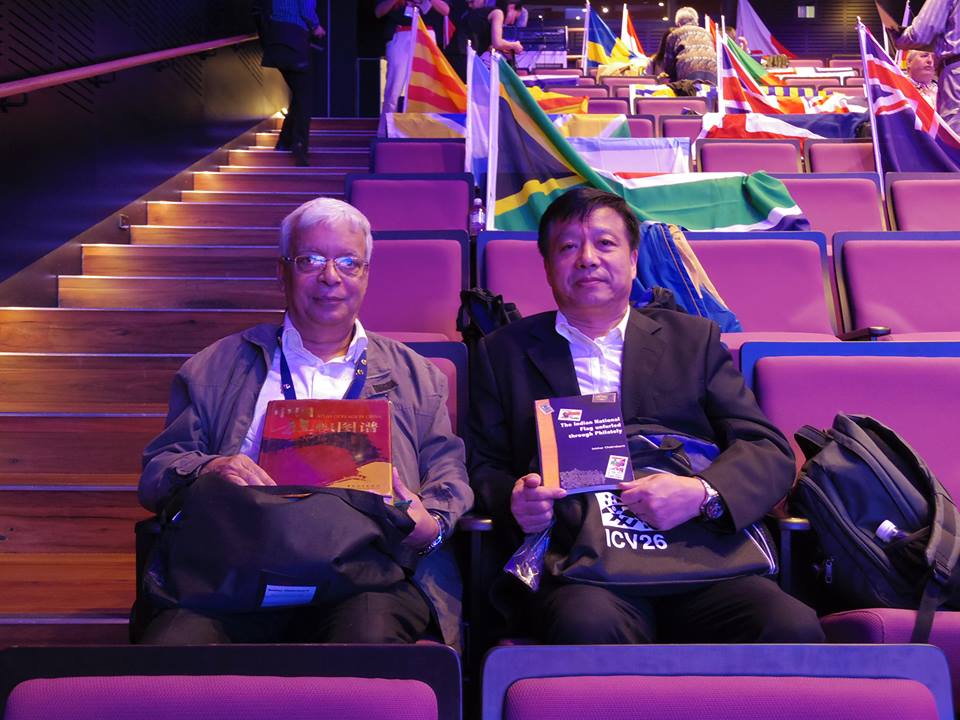
“Flags and Stamps” was represented by Sekhar Chakrabarti. He was the sole Indian participant in Sydney Flag Congress. Mr Ralph Kelly, Chair of the Organising Committee for ICV 26, in his letter of invitation on behalf of Flags Australia dated 3 October 2014 wrote; “Our Sydney International congress will be honoured to have you attend. I have pleasant recollections of meeting you in Rotterdam at the 25th ICV and I greatly appreciated your lecture on the ancient symbols of Indian culture. Your scholarship and contribution to vexillology, philately and national identity in India reflected in your book The Indian National Flag unfurled through Philately, a copy of which is in my personal collection”.


On day 2 (Tuesday, 1st September) Mr Chakrabarti delivered his PPT presentation titled “An early 20th century Indian National Flag remembering the contribution of an Irish lady made 110 years ago”. It was an attempt to unravel one of the little known aspects of an early proposal for an All India National Flag designed by Sister Nivedita – an Irish lady, resettled in India.
 
 
Jonathan Dixon of ‘Flags Australia’ reports in the Flags of the World (FOTW); “Sekhar Chakrabarti led us to the contribution of an Irish lady to an early 20th century Indian flag by first reflecting on the women celebrated as first flag makers of national flags - in the USA, Philippines, Haiti and Cuba. In contrast, an early proposed Indian national flag was designed by Sister Nivedita. Born Margaret Noble, she was an Irish woman in India at a time when the 1905 partition of India prompted the beginning of the Swadeshi nationalist movement.  She was one of the earliest to suggest that they needed a national flag, and designed a flash employing a yellow thunderbolt symbol, inspired by the Vedas, on a red field between 108 flames and Bengali text meaning "hail to the mother”. This text also appears on later nationalist flags”.
 Placed here are a few images of the Sydney Flag Congress;

Sydney Observatory Hill Flag display (1st Sept)


Day 3 (2nd Sept): On way to Canberra by bus, seen here Dr David F. Phillips, Director North American Institute of Heraldic and Flag Studies, and Prof. Michel Lupant, President, FIAV
 
  Catching up with friends with a shared interest at an informal FOTW meeting at Barracks on Barrack.


The special post mark commemorating 17th ICV in 1997, Cape Town, South Africa. Perhaps, it is the only philatelic example on International Flag Congress - a present from Mr Bruce Berry of the South African Vexillological Association (SAVA). 
  
Ralph Kelly and Ralph Bartlett of Flags Australia at the Mt Ainslie Lookout in Canberra (original removed and the cropped version re-posted on 30th Sept.) the duo of the three main architects of the ICV26, who made the Sydney ICV, a GRAND SUCCESS and the most memorable one.


Sunday, July 12, 2015

Mahatma Gandhi on the National Flag of India

Mohandas Karamchand Gandhi (1869-1948), in the eyes of his admirers,  “Mahatma” (Great Soul).
Mahatma Gandhi for the first time came up with his ideas/views on the National Flag of India through an article published in ‘Young India’ in April 1921.  
  “A flag is a necessity for all nations. Millions have died for it, it is no doubt a kind of idolatry which it would be a sin to destroy. For a flag represents an ideal. The unfurling of the Union Jack evokes in the English breast sentiments whose strength it is difficult to measure. The Stars and Stripes mean a world to the Americans. The Star and the Crescent will call forth the best bravery in Islam. It will be necessary for us Indians - Hindus, Mohammedans, Christians, Jews, Parsis, and all others to whom India is their home - to recognise a common flag to live and to die for”.
 

The Tricolour, known as ‘Swaraj flag’ was first evolved at AICC meeting at Bejwada in 1921 when a ‘green and red’ flag made by Pingali  Venkayyaa and improved by Mahatma Gandhi with the addition of a white stripe at the top. The idea of ‘charkha’ came from Lala Hansraj of Jalandhar.

Gandhi explained in his aforesaid article ‘The National Flag’, 
The white portion is intended to represent all other faiths. The weakest numerically occupy the first place. The Islamic colour comes next; the Hindu colour red comes last, the idea being that the strongest should act as a shield to the weakest ... to represent the equality of the least of us with the best, an equal part is suggested to all three colours in the design. ...The regulation size of the flag should contain the drawing of a full sized spinning-wheel.
In early 1947 the British decided to quit India. Admiral of the Fleet Earl Mountbatten of Burma - the last Viceroy and the first Governor General of India put forward a proposal on 24 June 1947 to the Congress and Muslim League leaders to include the Union Jack at the canton of their respective National flags, so as to reflect the symbolic continuity with Britain.
I have expressed a hope that I would be able to persuade the new Dominions to have the Union Jack in the upper canton of their flag, as do other members of the Commonwealth. This design has not been accepted by either party. I have not pressed the leaders further…..  Jinnah, in turning down the suggestion, explained that it would be repugnant to the religious feelings of the Muslims to have a flag with a Christian Cross alongside the Crescent. Nehru asked if I would mind if Congress rejected the design on the grounds that although Gandhi, Patel and others had originally expressed their willingness to accept it, they had now come to the conclusion that the general feeling among the Congress extremists was that the leaders were pandering far too much’ 


Reconstructed image of the proposed flag for India by Mountbatten (image created by Zachary Harden).
  Leonard Moseley in his book The Last Days of the British Raj (Harcourt, Brace and World, Inc.; First Edition 1962) writes;

    "In the case of the flags for the new Dominions, the Viceroy had not been inactive. Among his hobbies, along with the compilation of his family tree, was heraldry and design. He himself sketched and prepared the design for the flags of both Pakistan and India. One was based on the flag of Congress -- with Gandhi's spinning wheel -- and the other on the Muslim League's crescent.  To each he added a small Union Jack, one ninth in area, sewn into the upper canton. He sent them to Jinnah and Nehru for their approval, as 'helpful suggestions'.                                                                                                                                  "Jinnah coldly replied that in no circumstances could the design be accepted as it would be repugnant to the religious feelings of the Muslims to have a Christian Cross alongside the Crescent. Nehru rejected the design on the grounds that, although Gandhi and Sardar Patel and others had originally expressed their willingness to accept it, he had now come to the conclusion that the prevailing feeling among Congress extremists was that the leaders were pandering to the British. This had reached a point where it was inadvisable to press the design upon them. Nehru sent the Viceroy a design prepared by Congress which showed the Dominion flag as closely resembling the Congress flag, but with the wheel of the Sarnath Asoka replacing the spinning wheel. And, of course, no Union Jack."  http://www.crwflags.com/fotw/flags/in!.html


Regarding the protest against the Viceroy’s proposal to include a small Union Jack in the Indian flag; Gandhiji saw, nothing wrong in that as long as India was a Dominion included in the British Commonwealth. Such a display would be an act of courtesy, and a gesture worthy of the best traditions built up in India. But, he had learnt at the Working Committee meeting that the Union Jack was not in fact going to be included. The Mahatma asked his audience not to rejoice over this omission!


Answering a question in a prayer meeting at New Delhi, Mahatma Gandhi had said, “But what is wrong with having the Union Jack in a corner of our flag? If harm has been done to us by the British it has not been done by their flag and we must also take note of the virtues of the British. They are voluntarily withdrawing from India, leaving power in our hands... It pains me that the Congress leaders could not show this generosity... If I had the power that I once had I would have taken the people to task for it. After all, why should we give up our humanity .

The Flag Committee chose the Asoka’s Dharma Chakra for the reason that amongst all the chakras that came to their mind the “Sarnath Chakra” was the most beautiful and artistic. On the flag, it would signify India’s continual progress and growth.


Mahatma Gandhi was not too happy with the replacement of the Charkha in the flag with Buddhist Emperor Asoka's Dharma Chakra (Wheel of Law). Though Nehru insisted that the change was not significant, Gandhi had his reservations, fearing that the association with the lion in the Asokan emblem would signify violence. He admitted in a statement published in the Harijan that, ‘Nothing would have lost if our councillors had never thought of interfering with the design of the original flag. In a statement made in Lahore on 6 August 1947, Gandhi said,
"I must say that, if the Flag of the Indian Union will not embody the emblem of the Charkha, I will refuse to salute that flag. You know the National Flag of India was first thought of by me, and I cannot conceive of India’s National Flag without the emblem of the Charkha". 
We have, however been told by Pandit Nehru and others that the sign of the Wheel or Chakra in the National flag symbolises the Charkha also ..."

On 15th August 1947 the people of Khulna (now in Bangladesh) hoisted the Indian tri-colour flag  thinking  Khulna will go to India but the Boundary Commission headed by Radcliffe awarded it to East Pakistan   (The boundary line, known as  Radcliffe Line, was published on 17th  August 1947 as a boundary demarcation between India and Pakistan) .
 
The people of Khulna called on Mahatma Gandhi who was then in Calcutta and ask him what is to be done to the hoisted tri-colour ? 
It was Gandhi’s ‘day of silence’, so, he wrote on a piece of paper:  
“There can be no two opinions, the Union flag must go. Pakistan’s must be hoisted without demur and with joy if possible. Award is award, good or bad”.