Protected by Copyscape Web Copyright Protection Software India Flag
India Flag by Expedia.com.au

Tuesday, February 21, 2012

Fiscals of the Princely State of Alwar


Flags and Coat-of-Arms
 by Col Jayanta Dutta

Alwar state formerly Rajputana Jaipur Residency; now in Rajasthan state, India.
 Area of state was 3,158 square miles, and population of state was 749,751 in 1931. Privy purse of state on the time of accession was Rs.5, 20,000/-
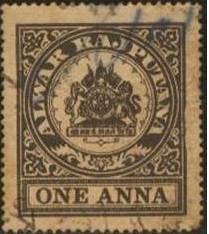
Alwar issued several series of adhesives and stamped papers. Not all had the coat of arms with the flag. Here we illustrate the issues which had the coat of arms with the flag. 
Court fees stamps

Second series is KM Type 10 (about 1920-1925): Different perforations are known, even e.g. 14 x 14 x 11 x 14, size 77x36mm, creamy wove paper, Watermark multiple rosettes.
 
Third series KM Type- 15 replaced Second series, bearing updated Coat-of-Arms
 Fourth series KM Type -16 used in 1931-49, bearing redrawn with smaller crown in Coat-of-Arms:  size 76x36mm. Perf. 12-1/2, Lithographed
 KM Types 5 to 16 were issued perforated, the next two series are known only imperforate.

Fifth series KM Type -17 imperforate
with Rajasthan State overprint.
The difference between these two types is the position of crown in Coat-of-Arms. Both series were valid between 1940-1949. Please note that many examples from Types 16-18 bear overprint Rajasthan in use after Independence
Then, 5 series of smaller Revenues for general purposes (or Non-judicials) are known (mostly differences are in Coat-of-Arms series, type of printing and perforations).

KM Type 31 - change of Coat-of-Arms: in 1910-25, size 25x30mm. Perf. 14, Wove paper.Printed on Watermarked paper
 Proof of KM Type 31 imperforate in carmine-red color
 KM Type-32, used 1920-25, size 24x28mm. Perf. 11-1/2, Wove paper
 1 Anna, pale brown
1 Anna, red brown
 1 Anna, black brown 
 KM  Type 33:  used in 1940-49, size 24x28mm. Imperf., Wove paper. The crown between the flags is narrow and teller.
KM Type 34:

Printed on unwatermarked paper
1 Anna, black-brown 
 Printed on thin unwatermarked paper 
 1 Anna, black-brown

 1 Anna, red brown, ovpt. Rajasthan  state
Type-34, used in 1945, size 24x28mm. Perf 14., Wove paper. The crown is dropped to a lower position between the flags.
 Essay in black
1 Anna, black brown
 Alwar issued also several stamped paper series for several specific usages.The first is for Hundis.
Three types are listed in KM. Here, 2 annas of Type 10: All these Hundis are very scarce.
 
Second issue is provisional issue, where Court Fee stamp was 'converted into Non-judicial' by overprint: Only 3 values are known from this Type
Much later, circa 1935 Alwar issued several designs, all with coat-of-arms in central part.
Type 22:
 Type 25 - not listed yet:
 And finally several series, all of them look very similar, they differ mostly in the printer inscription at right bottom:
Type 34: GOVT PRESS, ALWAR
 Type 36: WATERLOW & SONS
Other series exist either with no imprint (Type 32) or STATE PRESS, ALWAR (Type 30) or THOMAS DE LA RUE (Type 40)-with changed coat-of-arms.
Here is photo of beautiful watermark (taken through light source) which bear most of the above-mentioned paper series:
                                                                     (To be continued)

Tuesday, February 14, 2012

Rise, Fall and Rise and Becoming of the Republic of Singapore:


Rise, Fall and Rise and Becoming of the Republic of Singapore
(FLAG EVENTS ARE INTERPRETIVE SYMBOLISM)
 Singapore had been a part of various local empires since it was first inhabited in the second century AD. 
Modern Singapore was founded as a trading post of the British East India Company by Sir Stamford Raffles in 1819 with permission from the Sultanate of Johor. The British obtained full sovereignty over the island in 1824 and Singapore became one of the British Straits Settlements in 1826.
 
The facsimile of the letter on the $2 stamp, written by Sir Stamford Raffles to Col. Attenbrooke on 10 June1819, reads ".... I have just planted the British Flag....", an  archival document of the British colonisation of Singapore.
  
    Singapore was occupied by the Japanese in World War II
On this day 15 February 1942, British forces in Singapore were forced to surrender unconditionally to the Japanese exactly seven days after the Japanese troops first stormed the island.


 Lt Gen. Arthur Percival, led by a Japanese officer, walks under a flag of truce to negotiate the capitulation of Allied forces in Singapore, on 15 February 1942 (Source: Wikipedia)
 
The Japanese insisted that Lt. General A.E.Percival, GOC in C, Malaya, himself march under a "White Flag" to the Old Ford Motor Factory in Bukit Timah to negotiate the surrender.


A lithographic print of a painting by an unknown Japanese artist showing the signing of the surrender documents in Singapore. General Percival is second from the left in the foreground opposite General Yamashita.

 The table, on which the surrender of Singapore was signed (Australian War Memorial)

Jubilant Japanese troops on the Singapore waterfront on 16 February 1942, the day after the surrender of British forces in Singapore. Singapore was called "Syonanto" from 1942 to 1945.    It was the name in Japanese.
 The Battle of Singapore was fought in the South-East Asian theatre of the Second World War when the Empire of Japan invaded the Allied stronghold of Singapore. Singapore was the major British military base in Southeast Asia.  The fighting in Singapore lasted from 8–15 February 1942. It resulted in the fall of Singapore to the Japanese, and the largest surrender of British-led military personnel in history. About 80,000 British, Indian and Australian troops became prisoners of war, joining 50,000 taken by the Japanese in the Malayan Campaign. British Prime Minister Winston Churchill called the ignominious 'fall of Singapore' to the Japanese the "worst disaster" and "largest capitulation" in British history. In just seven days, Singapore, the "Impregnable Fortress", had fallen.
(Source: Wikipedia) 

 With the turn of events in the World War II and the irony of fates on 15 August 1945, Japan announced its surrender. 

 
The formal signing of the surrender instrument was held at City Hall, Singapore, then known as "Municipal Hall", on 12 September 1945. This was followed by a celebration at the Padang, which included a victory parade. Lord Louis Mountbatten, Supreme Allied Commander of South East Asia Command, came to Singapore to receive the formal surrender of the Japanese forces in the region from General Seishirō Itagaki on behalf of General Hisaichi Terauchi. A British military administration utilizing surrendered Japanese troops as security forces was formed to govern the island until March 1946.
  
The formal surrender by Japanese General Itagaki Seishiro of his sword, Kuala Lumpur,1946. Gen. Seishiro commanded the Japanese Seventh Area Army in Singapore and Malaya prior to the surrender. From a collection of official photographs collected by Major General (later Lieutenant General) Sir Frank Walter Messervy.(National Army Museum Copyright).
The Advertiser, Adelaide, South Australia, September 14 , 1945
 The British Union Jack flies above a cheering crowd during the arrival of the 5th Indian Division at Singapore, which marked the end of three and a half years of Japanese occupation. (http://en.wikipedia.org/wiki/File:SE_004648.jpg)
- See more at: http://app.singapore.sg/about-singapore/national-symbols#sthash.WTEdcbZ6.dpuf
The British granted internal self-government of Singapore in 1959. 
  
The above two stamps, released in 1960, are the first stamps depicting new National flag of Singapore to have the words “State of Singapore” printed on them.
 On 31st August 1963, Singapore declared independence from Britain. Singapore became part of Malaysia between 1963 and 1965. On 9 August 1965, it broke away from Malaysia and became a fully independent sovereign nation styled as the Republic of Singapore.
Former Deputy Prime Minister, Dr Toh Chin Chye, who in 1959 headed a committee to conceive and create the National Flag and the State Crest, explained the need for National Symbols in an oral history interview with the National Archives of Singapore:
"They were necessary symbols… since although we were not really independent in 1959 but self-governing, it was necessary right from the beginning that we should rally enough different races together as a Singapore nation." - Dr Toh Chin Chye, 1989.
- See more at: http://app.singapore.sg/about-singapore/national-symbols#sthash.WTEdcbZ6.dpuf
Former Deputy Prime Minister, Dr Toh Chin Chye, who in 1959 headed a committee to conceive and create the National Flag and the State Crest, explained the need for National Symbols in an oral history interview with the National Archives of Singapore:
"They were necessary symbols… since although we were not really independent in 1959 but self-governing, it was necessary right from the beginning that we should rally enough different races together as a Singapore nation." - Dr Toh Chin Chye, 1989.
- See more at: http://app.singapore.sg/about-singapore/national-symbols#sthash.WTEdcbZ6.dpuf
Former Deputy Prime Minister, Dr Toh Chin Chye, who in 1959 headed a committee to conceive and create the National Flag and the State Crest, explained the need for National Symbols in an oral history interview with the National Archives of Singapore:
"They were necessary symbols… since although we were not really independent in 1959 but self-governing, it was necessary right from the beginning that we should rally enough different races together as a Singapore nation." - Dr Toh Chin Chye, 1989.
- See more at: http://app.singapore.sg/about-singapore/national-symbols#sthash.WTEdcbZ6.dpuf
Former Deputy Prime Minister, Dr Toh Chin Chye, who in 1959 headed a committee to conceive and create the National Flag and the State Crest, explained the need for National Symbols in an oral history interview with the National Archives of Singapore:
"They were necessary symbols… since although we were not really independent in 1959 but self-governing, it was necessary right from the beginning that we should rally enough different races together as a Singapore nation." - Dr Toh Chin Chye, 1989.
- See more at: http://app.singapore.sg/about-singapore/national-symbols#sthash.WTEdcbZ6.dpuf
Former Deputy Prime Minister, Dr Toh Chin Chye, who in 1959 headed a committee to conceive and create the National Flag and the State Crest, explained the need for National Symbols in an oral history interview with the National Archives of Singapore:
"They were necessary symbols… since although we were not really independent in 1959 but self-governing, it was necessary right from the beginning that we should rally enough different races together as a Singapore nation." - Dr Toh Chin Chye, 1989.
- See more at: http://app.singapore.sg/about-singapore/national-symbols#sthash.WTEdcbZ6.dpuf
Former Deputy Prime Minister, Dr Toh Chin Chye, who in 1959 headed a committee to conceive and create the National Flag and the State Crest, explained the need for National Symbols in an oral history interview with the National Archives of Singapore:
"They were necessary symbols… since although we were not really independent in 1959 but self-governing, it was necessary right from the beginning that we should rally enough different races together as a Singapore nation." - Dr Toh Chin Chye, 1989.
- See more at: http://app.singapore.sg/about-singapore/national-symbols#sthash.WTEdcbZ6.dpuf


Former Deputy Prime Minister, Dr Toh Chin Chye, who in 1959 headed a committee to conceive and create the National Flag and the State Crest, explained the need for National Symbols in an oral history interview with the National Archives of Singapore:
"They were necessary symbols… since although we were not really independent in 1959 but self-governing, it was necessary right from the beginning that we should rally enough different races together as a Singapore nation." - Dr Toh Chin Chye, 1989.http://app.singapore.sg/about-singapore/national-symbols

Former Deputy Prime Minister, Dr Toh Chin Chye, who in 1959 headed a committee to conceive and create the National Flag and the State Crest, explained the need for National Symbols in an oral history interview with the National Archives of Singapore:
"They were necessary symbols… since although we were not really independent in 1959 but self-governing, it was necessary right from the beginning that we should rally enough different races together as a Singapore nation." - Dr Toh Chin Chye, 1989.
- See more at: http://app.singapore.sg/about-singapore/national-symbols#sthash.WTEdcbZ6.dpuf
Former Deputy Prime Minister, Dr Toh Chin Chye, who in 1959 headed a committee to conceive and create the National Flag and the State Crest, explained the need for National Symbols in an oral history interview with the National Archives of Singapore:
"They were necessary symbols… since although we were not really independent in 1959 but self-governing, it was necessary right from the beginning that we should rally enough different races together as a Singapore nation." - Dr Toh Chin Chye, 1989.
- See more at: http://app.singapore.sg/about-singapore/national-symbols#sthash.WTEdcbZ6.dpuf

Former Deputy Prime Minister, Dr Toh Chin Chye, who in 1959 headed a committee to conceive and create the National Flag and the State Crest, explained the need for National Symbols in an oral history interview with the National Archives of Singapore:
"They were necessary symbols… since although we were not really independent in 1959 but self-governing, it was necessary right from the beginning that we should rally enough different races together as a Singapore nation." - Dr Toh Chin Chye, 1989.
- See more at: http://app.singapore.sg/about-singapore/national-symbols#sthash.WTEdcbZ6.dpuf


Monday, February 13, 2012

FLAGS ON INDIAN PRINCELY STATE FISCALS -


 Alipura State Fiscals
By; Colonel Jayanta Dutta of Armed Forces Medical College, Pune
Alipura was a princely state in what is today the Chhatarpur District in the Indian state of Madhya Pradesh. 
The fiscal stamps bore the coat of arms of the erstwhile Alipura state which had flags of the state.
Alipura issued only one series of Court Fees and one series of Revenue stamps (general purpose).
Court Fee series

 
  On some of the Court Fee stamps is handstamped indicating use in Charkhari state (not yet reported) - in the centre
 Revenue stamp series
 Also, one type of stamped papers is known
 To be continued


Sunday, February 12, 2012

FLAGS ON INDIAN PRINCELY STATE FISCALS


Colonel Jayanta Dutta, MD, FISCD, FIPHA, FCCP of Armed Forces Medical College, Pune and an well-known philatelist of India has kindly agreed to contribute articles on fiscals related to Flags.
Here goes the first installment;

Do you know India had nearly 550 princely states and nearly 250 of this states had their own Court Fee and Revenue stamps. Many of these states were too small in area and population, so such stamps were issued in very small quantity.  And even major part from the issued stamps were either destroyed by government relative agency (ies) or found in damaged condition. So, available quantity is supposed to be a minor part of the stamps issued. If you are collecting post-independence, thematically or foreign stamps or say foreign currency notes or post independence notes or coins, this would be an endless collection because everyday new issues comes out and you have to keep on updating your collection regularly.
On the other hand, if you are collecting Indian native states fiscals, there is nothing new is going to be issued, thereby one can try and make a complete collection, and mind you these stamps were not for public use. All these states had issued few stamps and we are still lucky that we can get these stamps, though, as usual, most of the stock has gone to the UK and USA as there is a foundation which has invested huge money and collected Indian princely states' fiscals and have also published a standard catalogue specially on fiscals of Indian princely states (Koeppel & Manners)
 
 For lovers of flags Indian Princely States fiscal offers many verities and I thought to begin with the whole exercise alphabetically with Akalkot state.

Akalkot was located in Bombay Residency. Akalkot had an area of 498 square miles, with about 90,000 inhabitants.
  Akalkot issued Court Fees, Receipts and 
Stamped papers. 
 
The first series of Court Fees bears the inscription Akalkot state. The flag exists in several sizes (not mentioned in K&M). Note that this Court Fee is unused and this is rare
 The second Court Fee series used changed spelling of state, now being Akalkat state. Note the doubling of red color (the flag and denomination).

 The third series included the flag in design and was not printed in second operation as opposed to the first two designs

Thursday, February 2, 2012

Wagah Border Sunset Parade and Beating the Retreat (Lowering of Flags of India and Pakistan)


In continuation of my post dated February 01, 2012,  I am pleased to add the write-up on 'Wagah Retreat Ceremony' sent to me by Mr. Dharminder Kapoor, Secretary of Amritsar Philatelic Club, Amritsar for the benefit of all discerning collectors. 
Thank you Mr. Kapoor.

Wednesday, February 1, 2012

Attari - Wagah Border Sunset Parade and Beating the Retreat (Lowering of Flags)


 A special cover on "Beating the Retreat Ceremony" at Attari-Wagah Border issued on 10 January 2012, commemorating Amritsar Philatelic Exhibition - AMPHIL- 2012

The Wagah border, locally known as the "Berlin wall of Asia”, is a border crossing on the India-Pakistan border where each evening there is a highly stylised “Retreat Ceremony” called 'lowering of the flags', which has been held uninterrupted since 1959.  At that time there is an energetic parade by the Border Security Force (BSF) of India and the Pakistan Rangers.  At the first glance it may appear  aggressive and even hostile to the spectators  but in fact the parades are imitating the pride and anger. Troops of each country pick some of their tallest troops – would strut furiously towards the line separating them, their one-foot high fan shaped turbans gleaming like crests. Almost when it seemed they would collide, the guards – the Pakistan Rangers in grey salwar-kameez, the Indian BSFs in khaki – would veer off with salutes that look more attempted blows. Then the National flags would be lowered, and the immense metal gates slammed shut with a satisfying clunk. 

In 2001 both sides erected grandstands for the crowds that gather there to cheer their respective border guards and hurl abuse at those of the other country. As cries of “Allah-o-Akbar”, “Pakistan Zindabad” rose from the Wahga side, shouts of “Bharat Mata Ki Jai”, “ Vande Mataram” and “Jai hind” would erupt from Atari side.

With the better and improving relations between the neighbours the aggressive gestures during the ritual of “Flag Lowering” undertaken at sunset while closing the gates at the border has now been greatly toned down.
An Independence Day cachet showing crossed ‘India-Pakistan flags’ on the cover from the Indian F.P.O. 112, in Japan.
This is perhaps only the only postal cover where the flags of both India and Pakistan appear together with a cancellation 15 Aug 1947”. This cover was conceived by the late Brig. D.S.Virk,“ the  doyen of the Forces Philately in India.

 Special postmark from Tashkent, dated 10 January 1967, commemorating the first anniversary of the ‘Tashkent Declaration—1966’.
The Prime Minister of India and the President of Pakistan, having met at Tashkent [Uzbekistan SSR] and having discussed the existing relations between India and Pakistan hereby declare their firm resolve to restore normal and peaceful relations between their countries and to promote understanding and friendly relations between their peoples. They considered the attainment of these objectives of vital importance for the welfare of the 600 million people of India and Pakistan.
 Long live friendships between India and Pakistan.