Protected by Copyscape Web Copyright Protection Software India Flag
India Flag by Expedia.com.au
Showing posts with label All India Congress. Show all posts

Wednesday, February 1, 2012

Attari - Wagah Border Sunset Parade and Beating the Retreat (Lowering of Flags)


 A special cover on "Beating the Retreat Ceremony" at Attari-Wagah Border issued on 10 January 2012, commemorating Amritsar Philatelic Exhibition - AMPHIL- 2012

The Wagah border, locally known as the "Berlin wall of Asia”, is a border crossing on the India-Pakistan border where each evening there is a highly stylised “Retreat Ceremony” called 'lowering of the flags', which has been held uninterrupted since 1959.  At that time there is an energetic parade by the Border Security Force (BSF) of India and the Pakistan Rangers.  At the first glance it may appear  aggressive and even hostile to the spectators  but in fact the parades are imitating the pride and anger. Troops of each country pick some of their tallest troops – would strut furiously towards the line separating them, their one-foot high fan shaped turbans gleaming like crests. Almost when it seemed they would collide, the guards – the Pakistan Rangers in grey salwar-kameez, the Indian BSFs in khaki – would veer off with salutes that look more attempted blows. Then the National flags would be lowered, and the immense metal gates slammed shut with a satisfying clunk. 

In 2001 both sides erected grandstands for the crowds that gather there to cheer their respective border guards and hurl abuse at those of the other country. As cries of “Allah-o-Akbar”, “Pakistan Zindabad” rose from the Wahga side, shouts of “Bharat Mata Ki Jai”, “ Vande Mataram” and “Jai hind” would erupt from Atari side.

With the better and improving relations between the neighbours the aggressive gestures during the ritual of “Flag Lowering” undertaken at sunset while closing the gates at the border has now been greatly toned down.
An Independence Day cachet showing crossed ‘India-Pakistan flags’ on the cover from the Indian F.P.O. 112, in Japan.
This is perhaps only the only postal cover where the flags of both India and Pakistan appear together with a cancellation 15 Aug 1947”. This cover was conceived by the late Brig. D.S.Virk, the  doyen of the Forces Philately in India.

 Special postmark from Tashkent, dated 10 January 1967, commemorating the first anniversary of the ‘Tashkent Declaration—1966’.
The Prime Minister of India and the President of Pakistan, having met at Tashkent [Uzbekistan SSR] and having discussed the existing relations between India and Pakistan hereby declare their firm resolve to restore normal and peaceful relations between their countries and to promote understanding and friendly relations between their peoples. They considered the attainment of these objectives of vital importance for the welfare of the 600 million people of India and Pakistan.
 Long live friendships between India and Pakistan.

Wednesday, April 6, 2011

Rabindranath Tagore and National Anthems of Bangladesh, India & Sri Lanka

It may sound unbelievable, but true that Asia's first Nobel Prize winner in Literature in 1913 Rabindranath Tagore was behind the three great national anthems of three great nations, viz. Bangladesh, India and Sri Lanka. In the recently concluded "ICC  World  Cricket Tournament - 2011" jointly organised by the said three countries, it was witnessed again  that the players of three different nationalities singing 'Anthems' created and inspired by the same genius for their respective nations.
.


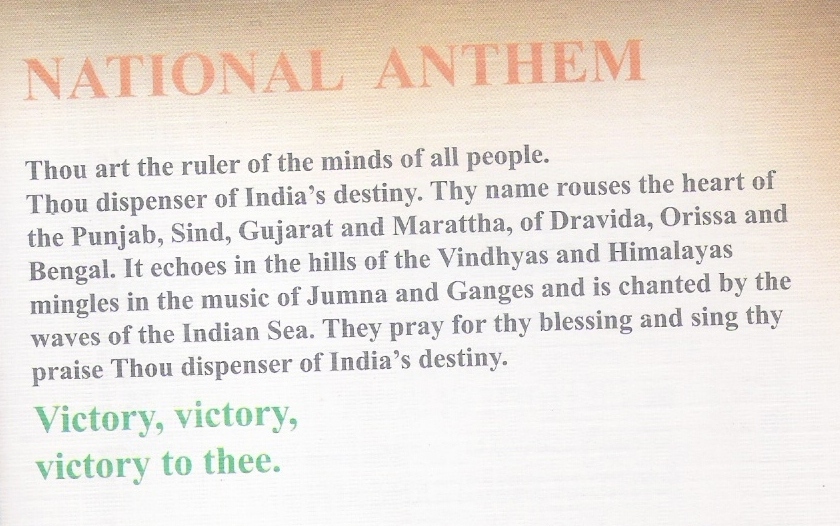
Indian National Anthem
Bangladesh National Anthem;
  Amar sonar Bangla,
Ami tomae bhalobashi.
           
My Bengal of Gold,
I love you.

Chirodin tomar akash,
Tomar batash,
Amar prane bajae bãshi.
           
Forever your skies,
Your air set my heart in tune
As if it were a flute.

O ma,
Phagune tor amer bone
Ghrane pagol kôre,
Mori hae, hae re,
O ma,
Ôghrane tor bhôra khete
Ami ki dekhechhi modhur hashi.
           
In spring, O mother mine,
The fragrance from your mango groves
Makes me wild with joy,
Ah, what a thrill!
In autumn, O mother mine,
In the full blossomed paddy fields
I have seen spread all over sweet smiles.

Ki shobha, ki chhaea go,
Ki sneho, ki maea go,
Ki ãchol bichhaeechho
Bôt,er mule,
Nodir kule kule!
          
Ah, what beauty, what shades,

What an affection, and what tenderness!

What a quilt have you spread

At the feet of banyan trees

And along the banks of rivers!


Ma, tor mukher bani

Amar kane lage,

Shudhar môto,

Mori hae, hae re,

Ma, tor bôdonkhani molin hole,

Ami nôeon jôle bhashi.


O mother mine, words from your lips

Are like nectar to my ears.

Ah, what a thrill!

If sadness, O mother mine,

Casts a gloom on your face,

My eyes are filled with tears!

Sri Lankan National Anthem

"Sri Lanka Matha" is the national anthem of Sri Lanka. The words and music were written by Ananda Samarakoon in 1940 in the Sinhala language, and was officially adopted as the national anthem on November 22, 1951 by a committee headed by Sir Edwin Wijeyeratne.The first line of the anthem originally read: "Namo namo matha, apa Sri Lanka". There was some controversy over these words in the 1950s, and in early 1962 they were changed to their present form.

Ananda Samarakoon was born George Wilfred Alwis to a Christian family in Padukka, in Ceylon, on January 13, 1911. 
 In 1936, Samarakoon left for Santiniketan in India to study art and music. After six months he abandoned his studies and returned to Sri Lanka, and changed his name to Ananda Samarakoon, embracing Buddhism. He was very much influenced by Rabindranath Tagore while in India and his fascination and the desire to imitate the great Indian musician would go on to take him in the direction of creating a musical tradition for the Sri Lankan people. During Samarakoon's stay in India, one of his early compositions, Namo Namo Mata (composed in 1940, recorded in 1946) was nominated as the national anthem and was officially adopted by the State as the Sri Lankan national anthem in 1952. Critics attacked Namo Namo Mata, particularly the "Gana" significance of the introductory words (Namo Namo Matha) which designate disease and ill luck. Samarakoon was not a believer in "Gana", and the criticism caused him to write numerous articles counter attacking his critics to defend his composition. However, without his consent, the introductory words were changed to "Sri Lanka Mathaa" so that the "Gana" significance now would designate victory and prosperity.

Sri Lanka Matha, apa Sri Lanka,                                                                                                            
    Namo Namo Namo Namo Matha.                                                                                                                                                                                  Sundara siri barini,
Surendi athi Sobamana Lanka
Dhanya dhanaya neka mal pala thuru piri, Jaya bhoomiya ramya.
Apa hata sapa siri setha sadana, jeewanaye Matha!
Piliganu mena apa bhakthi pooja,
Namo Namo Matha.
Apa Sri Lanka,
Namo Namo Namo Namo Matha
Obawe apa widya, Obamaya apa sathya
Obawe apa shakti, Apa hada thula bhakthi
Oba apa aloke, Aapage anuprane
oba apa jeewana we, Apa muktiya obawe
Nawa jeewana demine
Nnithina apa Pubudu karan matha
Gnana weerya wadawamina ragena yanu
mena jaya bhoomi kara
Eka mawekuge daru kala bawina
yamu yamu wee nopama
Namo Namo Matha
Apa Sri Lanka,
Namo Namo Namo Namo Matha.
 Translated
Mother Lanka we salute Thee!
Plenteous in prosperity, Thou,
Beauteous in grace and love,
Laden with grain and luscious fruit,
And fragrant flowers of radiant hue,
Giver of life and all good things,
Our land of joy and victory,
Receive our grateful praise sublime,
Lanka! we worship Thee.
Thou gavest us Knowledge and Truth,
Thou art our strength and inward faith,
Our light divine and sentient being,
Breath of life and liberation.
Grant us, bondage free, inspiration.
Inspire us for ever.
In wisdom and strength renewed,
Ill-will, hatred, strife all ended, In love enfolded, a mighty nation
Marching onward, all as one,
       Lead us, Mother, to fullest freedom.
In 1945 Samarakoon's only son died at the age of five and the grieving Samarakoon left Sri Lanka for India where he pursued a painting career and held eleven art exhibitions there. Though his painting were critically acclaimed, he returned to music in 1951 back in Sri Lanka. On April 5, 1962, at the age of fifty one, Samarakoon committed suicide. 

******************