White Flag; Flag of
Truce or Surrender
White
flag
when carried by a lone soldier between two fighting armies or if hoisted at sea
at a ship’s mast will instantly stop a battle.
It is recognized internationally as protective
sign
of truce or ceasefire,
and request for negotiation. It is also
used to symbolize surrender, since it is often
the weaker military party which requests negotiation.

The first mention of the usage of white flags
to surrender is made during the Eastern
Han
dynasty (A.D 25–220). In the Roman
Empire, the historian Cornelius
Tacitus mentions a white flag of surrender in A.D. 109. Before
that time, Roman armies would surrender by holding their shields above their
heads. (Wikipedia).
The white
flag was widely used in the middle Ages in Western Europe to indicate
intent to surrender. This custom became
widespread in the tenth century during the French feudal wars. The Church
compelled the barons to agree to stop fighting on certain saint’s days, and
from Saturday to Monday, and respect la treve de Diew (the truce of God) or to be
excommunicated. The custom originating in the south of France, the hoisting of the Church’s white flag of
purity to ask for a truce spread over Europe. For curiously, while it is the
only flag that is today used by all nations alike, no regularly made “Flag of truce” is found in any Army or
Navy flag-lockers. It is improvised when the emergency arises for its use
from sheets, tablecloths or any white material at hand. (Source: Your Flag and Mine, p.131, 132).

Its use may have expanded across continents,
e.g. Portuguese chronicler Gaspar
Correia (writing in the 1550s), claims that in 1502, an Indian
prince, the Zamorin of Calicut,
dispatched negotiators bearing a "white cloth tied to a stick",
"as a sign of peace", to his enemy Vasco
da Gama. (Wikipedia).
In 1625, Hugo Grotius (1583 – 1645), also known as Huig de Groot, a Dutch jurist in his book ‘De jure belli ac pacis libri tres’ (translated, ‘On the Law of War and Peace: Three books’), one of the foundational texts in international law, recognized the White flag as a "sign, to which use has given a signification;" it was "a tacit sign of demanding a parley, and shall be as obligatory, as if expressed by words."(Wikipedia).


The
surrender of Lord Cornwallis to
French (left) and American (right) colonial
forces after the battle
of Yorktown (1781).

This painting (by John Trumbull) depicts the
forces of British Major General Charles Cornwallis, 1st Marquess Cornwallis
(1738-1805) (who was not himself present at the surrender), surrendering to
French and American forces after the Siege of Yorktown (September 28 – October
19, 1781) during the American Revolutionary War
A white
flag signifies to all that an approaching negotiator is unarmed, with
intent to surrender or a desire to communicate. Persons carrying or waving a
white flag are not to be fired upon, nor are they allowed to open fire. Modern
nations have recognized this time-honoured custom and the simple waving of a white cloth will instantly stop a battle. The
use of a white flag to surrender is included in the Hague
Conventions of 1899 and 1907.
Italy
is perhaps the only country whose flag guidelines specifically mention the ‘White
flag’ as an indication that a fighting force wants to call for a parley, or
surrender negotiations, writes Brendan Koerner.
The improper use of a White flag is forbidden
by the ‘rules of war’ (Is there any?) and constitutes a war crime of treachery.
There have been numerous reported cases of such behavior in conflicts, such as
fighters using White flags as a trick to approach and attack enemies, or
killings of fighters attempting to surrender by carrying white flags.
Fact File

The Mayor of Jerusalem Hussein al-Husayni
(centre) meets with soldiers of the British Egyptian Expeditionary Force on
December 9, 1917, under the white
flag
of surrender. The Battle of Jerusalem had
begun the day before, but the Turkish
forces in the city were no match against the British forces. A Turkish
counterattack on December 25 was also repulsed, confirming the capture of Jerusalem by
the Allies. http://en.wikipedia.org/wiki/Template:POTD_protected/2009-12-09


Lt
Gen. Arthur Percival,
led by a Japanese officer, walks under a flag
of truce to negotiate the capitulation of Allied forces in Singapore, on
15 February 1942 (Wikepedia)

The
Japanese insisted that Lt. General A.E.Percival, GOC in C, Malaya,
himself march under a "White Flag" to the Old Ford Motor
Factory in Bukit Timah to negotiate the surrender.

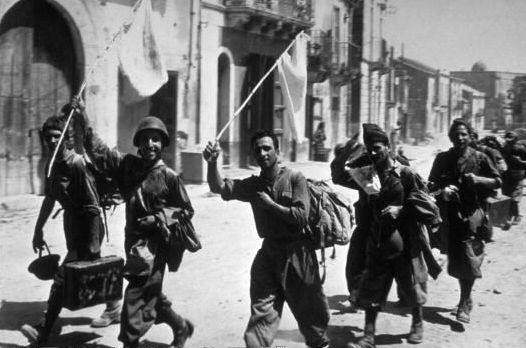
The Italian Government surrendered its
forces to the Allies on 8 September 1943, and on the following day General Mark
Clark launched Operation Avalanche, the landing of Allied troops on the coast
of Italy, near Salerno. http://www.holocaustresearchproject.org/nazioccupation/italianjews.html

German soldiers waving a white flag
of surrender . May 13, 1945. http://collections.yadvashem.org/photosarchive/en-us/96451.html

Iraqi
Soldiers Surrendering to US and British Troops. Two
Iraqi soldiers hold up the white flag of surrender.
http://www.samliquidation.com/chabad_4-c.htm
Why Do Surrendering Soldiers Wave White Flags? How did
this tradition originate?
By Brendan Koerner
http://www.slate.com/articles/news_and_politics/explainer/2003/03/why_do_surrendering_soldiers_wave_white_flags.html
Ancient historians from both China and Rome
noted the use of white flags to signal surrender. In the former empire, the
tradition is believed to have originated with the reign of the Eastern Han dynasty (A.D 25-220),
though it may be somewhat older. The
Roman writer Cornelius Tacitus mentions a white flag of surrender in his Histories, first published in A.D. 109. His
reference concerns the Second Battle of Cremona, fought between the Vitellians
and the Vespasians in A.D. 69; at the time, the more common Roman token of
surrender was for soldiers to hold their shields above their heads. It is
believed that the tradition developed independently in the East and West.
As for the bland color selection, it was
likely just a matter of convenience in the ancient world. Artificial colors
were still centuries away, so white clothes were always handy—not to mention
highly visible against most natural backgrounds. Vexillologists (those who
study flags) also opine that plain white provided an obvious contrast to the
colorful banners that armies often carried into battle.
The
peacemaking symbolism of the white flag is now enshrined in the Geneva Convention, though it's rarely mentioned in
national flag codes.
Iraqi soldiers are well aware that simply
waving a white handkerchief can save their necks. So, too, are their
commanders. In the last Gulf War, many Iraqi army officers forced their
conscripts to hand over any and all articles of white clothing, including
undershirts and socks, lest they be tempted to surrender to American forces.
Fortunately for the troops, putting one's hands above one's head is often an
equally effective way to cry "Uncle!"
Black
spot on White Flag
India and Pakistan have
accused each other of misusing the White
flag in the border skirmish across the LoC in Jammu and Kashmir in 2008.

Bullet
marks on ceasefire sanctity
New
Delhi, July 29: A nearly five-year-long ceasefire along the Line of Control in
Jammu and Kashmir was teetering today after the Pakistani and Indian armies
traded fire for over 16 hours overnight and India’s defence minister alleged
that Pakistan had violated the truce of November 2003
Most important,
the Indian and Pakistani armies have traded charges on misuse of a symbol of
peace — the white flag — that rival militaries in battlefields rely on to
signal a temporary truce to recover the dead and the injured. This action and
the suspicion of intentions mean that the sanctity of the ceasefire on the LoC
is already in tatters.

.svg.png)