Protected by Copyscape Web Copyright Protection Software India Flag
India Flag by Expedia.com.au

Tuesday, August 30, 2011

FLAGS OF LIBYA


The rebels under the leadership of the National Transitional Council of Libya is all set to over throw the Gaddafi regime. As a result of the 2011 Libyan Civil war, there are currently two governments claiming to be the de jure government of Libya. One government is led by Muammar al-Gaddafi and the General People’s Committee, and the other is the National Transitional Council. 
The National Transitional Council, formed on 27 February 2011, adopted the flag previously used in ‘Kingdom of Libya’ between 1951 and 1969 as the "flag of the Libyan Republic". The capital town Tripoli is already dressed overall with red over black over green tricolours of the old Kingdom. The  tricolour is once again flying everywhere – on streets, windows, cars and even on people’s faces. It appears, as if, there are no other flags in Libya. The Arab League on 27 August 2011 approved the Libyan rebels’ flag as the new National flag of Libya, replacing the one used by Muammar Gaddafi at the extra-ordinary meeting of Arab foreign ministers under the chairmanship of HE Youssef Bin Alawi, Minister Responsible for Foreign Affairs in Cairo.
 Originally part of the Turkish Empire, Libya was ceded to Italy. From 1912 to 1927, the territory of Libya was known as Italian North Africa. From 1927 to 1934, the territory was split into two colonies -  Italian Cyrenaica and Italian Tripolitania, run by Italian governors.  In 1934, Italy adopted the name "Libya" after the historical name for Northwest Africa, from Greek Λιβύη (Libúē ) and the Tricolour of Italian Kingdom became the flag of Italian occupied Libya. During World War II, ‘Italian Libya’ was occupied by France and the United Kingdom.
 
The Libyan tricolour was originally adopted when United Kingdom of Libya was established in accordance with a United Nations Resolution on 24th December 1951. It united Tripolitania, Cyrenaica and Fezzen under the Amir of Cyrenaica who became King Idris. The flag of the Kingdom had three horizontal stripes; the pattern as a whole was in conformity with the popular Pan Arab Renaissance colours. The three parts of the flag were also said to represent the three parts of the country. The width of the black stripe was equal to that of the red and green combined. As a matter fact, the original flag of the Amir of Cyrenaica was black with a white crown in the hoist and white star and crescent in the centre.
On 1st September 1969, the regime was overthrown, the King deposed and the new Libyan Arab Republic was proclaimed by the military government under Col. Gaddafi. On 7th November 1969 the old flags were superseded by one which is basically similar to that of other ‘liberated’ Arab countries often referred to as ‘Nasserite’ colours that is ‘red over white over black’ horizontal tricolour, introduced by President Nasser of Egypt, but with no stars in the centre.
On 1st January 1972, Libya entered the Federation of Arab Republics, along with Syria and Egypt, when a common flag of red over white over black charged with an almost identical ‘coat of arms’  was adopted. 
 Libya however, left the Federation in 1977 and adopted an all Green flag, when the ‘Jamahiriya’ or Commonwealth was formed styled as the Socialist People’s Libyan Arab Jamahirya (al-Jamahariya al-Arabiya al-Libya al-Shabiya al-Ishtirakiya al-Uzma). The plain green flag of Libya is happened to be the only monochromatic National flag of the world. The green is perceived as the colour of Islam, the traditional colour of the Fatimid dynasty of the caliphs, which ruled in North Africa from AD 909 to 1171 and also a manifestation of the ‘Green Revolution’ proclaimed by Col. Gaddafi.

Wednesday, August 17, 2011

Egyptian National Flags on Postage Stamps


After completion of  very successful Philatelic exhibition in Cairo on Rabindranth Tagore held in commemoration of his 150 years of birth, I have come back to Kolkata and now once again geared up to resume my blog which was in dormant for quite some time. The exhibition in Cairo was greatly publicised by all the news papers in Cairo. I am prompted to reproduce here at least one from the Egyptian Gazette of Saturday, July 9, 2011 just a day after the biggest rally when hundreds of thousands of Egyptians staged one of their biggest demonstrations in Cairo at Tahrir Square on 8th July to demand swift justice for victims of the former regime.
In Metro Rail with the demonstators on their way to 
Tahrir Square.
At Tahrir Square on 8th July 2011
Page six of the Egyptian Gazette , Cairo of the same date
  Let me now discuss about the Egyptian National Flag to the best of my ability and knowledge. I shall be glad if anybody correct me where I have gone wrong.
 Egypt had a number of National flags. Under the Turkish rule Egypt’s flag was ‘Red and bore three Crescents, each with a five pointed star within its horns, all in white’. The flag was in vogue from 1914 to 1922.
 On becoming an independent kingdom in 1922, Egypt changed her flag to ‘Green with one white Crescent’. The flag remained its National status till 1958.
 King Farouk had no less than four Royal standards; the one that resembled the National Flag, but had a small ‘Royal Crown’ in colour in the upper left-hand corner.
 King Farouk raising Egyptian Flag over Kasr-el-Barracks after British withdrawal from the Nile delta.

With the abolition of Monarchy, after the revolution of 1952, the ‘Red-White-Black’ of three equal horizontal stripes was introduced in Egypt. The colours symbolized the period of oppression (black) over come through bloody struggle (red) to be replaced by a bright future(white). This flag , considered by many as the second generation of ‘Pan-Arab colours’. The colours  became the inspiration for the flags of many other Arab Nations which chose the republican political system. The symbolism was explained by poet Safi al-Din-al-Hili as:

“White are our deeds, black are our battles,

Green are our fields, red are our knives”.
The National Flag of United Arab Republic (1958-1961) and Egypt (1961-1973)
The central white stripe was charged with two ‘Green Stars’ in 1958 with the formation of the United Arab Republic (UAR) with Syria.
 Second anniversary of the proclamation of the UAR, 1960
 In 1984 Egypt withdrew from the Federation of Arab Republic founded in 1971 by Egypt, Libya and Syria. The Federation was virtually became inactive since Egypt broke off diplomatic relations with Libya in 1973, on the other hand Syria broke off diplomatic relations with Egypt after ‘1979 Peace Treaty’ with Israel signed by President Anwar Sadat. 
 20th anniversary of revolution, 1972
 Egypt also replaced the ‘Qureish Falcon’ named after the tribe of Prophet Mohammed and introduced by Gamal Abdel Nasser by the ‘Eagle of Saladin’ on Egypt’s national emblem. Saladin was the Sultan of Egypt and Syria who in 1187 had defeated the Christians, near Tiberas and conquered Jerusalem, sparking the third Crusade.


Tuesday, June 28, 2011

Philatelic Exhibition on Rabindranath Tagore, Cairo, Egypt.


Press Release No. 28
June 16, 2011

MAULANA AZAD CENTRE FOR INDIAN CULTURE

EMBASSY OF INDIA

23, Talaat Harb Street, Down Town, Cairo

150th birth anniversary celebrations of Rabindranath Tagore
Tagore Exhibition at El Bab Gallery, 5-17 July, 2011

To commemorate the 150th birth anniversary of Gurudev Rabindranath Tagore, the Maulana Azad Centre for Indian Culture (MACIC), Embassy of India, Cairo, in cooperation with the Foreign Cultural Relations Sector and the Fine Arts Sector of the Egyptian Ministry of Culture will be bringing two exhibitions related to Tagore which will be inaugurated on 5 July, 2011 at 7 p.m by H.E Dr Emad Abou Ghazi, the Egyptian Minister of Culture and H.E Mr R.Swaminathan, Ambassador of India at El Bab Gallery at the Opera House Complex. The function will be graced by H.E Mr Hossam Nassar, First Under Secretary for Foreign Cultural Relations and H. E Dr Ashraf Reda, Head of the Fine Arts Sector.

Rabindranath Tagore (1861-1941) was the first Asian Nobel Laureate. He won the Nobel Prize for Literature in 1913.  Tagore was a master of several literary forms – he was a poet, a novelist, a short-story writer and a playwright. His contributions reshaped Bengali literature and music in the late 19th and early 20th century. Tagore is perhaps the world’s only writer whose compositions have been adopted as the national anthems of two countries: India and Bangladesh. At the age of 60, Tagore also became a celebrated painter. Tagore was also a pioneering educationist (thus the honorific ‘Gurudev’ meaning ‘Teacher’), and greatly promoted rural reconstruction. He set up a school, Santiniketan, and thereafter, a world famous university called Visva Bharati in West Bengal, India as well as a centre for promotion of traditional arts and crafts in Sriniketan. He was a national leader and an internationalist who visited many countries including Egypt in 1925.
 The Tagore exhibitions will consist of two elements: (i) ‘A Philatelic Exhibition on Tagore’ which consists of 20 panels of commemorative stamps and other rare philatelic objects issued by the postal departments of around 20 foreign countries on Rabindranath Tagore. Some of these items are more than a century old and belong to private collectors in India. Mr Sekhar Chakrabarti, one of three Indian collectors, whose collections are used in this exhibition, will be the curator for the show at Cairo; and (ii) ‘Tagore on Kantha which includes 13 panels of ‘kantha’ work illustrating Tagore’s short stories, songs, poems, dance dramas all made in the traditional ‘kantha’ style of embroidery practiced to this day by rural women in West Bengal, India and in Bangladesh. Tagore greatly promoted traditional arts and crafts including Kantha work. Kantha work basically uses the ‘running stitch’ to create beautiful motifs on fabric. It was originally used by Bengali women for making quilts from old, worn out saris. The Kantha exhibition has been conceptualized by Ms Shamlu Dudeja who has worked for over 25 years for the revival of kantha work in West Bengal through the setting up of NGOs.
 The two exhibitions are being sponsored by the Indian Council for Cultural Relations (ICCR), New Delhi and have been put together by ICCR’s Rabindranath Tagore Centre in Kolkata. The exhibits are travelling out of India for the first time. The exhibition will run until 17 July, 2011 at the El Bab Gallery.

 For further details, please contact (i) MACIC at: Tel: 23933396 / 23960071; Fax: 23936572; e-mail: macic@indembcairo.com and (ii) on Facebook (Foreign Cultural Relations).

Earlier the same Philatelic Exhibition was held at the Rabindranath Tagore Centre in Calcutta organised by the Indian Council of Cultural Relations, Ministry of External Affairs, Govt of India .Courtesy Sekhar Chakrabarti and Moloy Sarkar.
 It may recalled that the first ever solo philatelic exhibition on Tagore was held by courtesy Sekhar Chakrabarti way back in 1966 organised by Indo-American Society, Calcutta.


Wednesday, April 6, 2011

Rabindranath Tagore and National Anthems of Bangladesh, India & Sri Lanka

It may sound unbelievable, but true that Asia's first Nobel Prize winner in Literature in 1913 Rabindranath Tagore was behind the three great national anthems of three great nations, viz. Bangladesh, India and Sri Lanka. In the recently concluded "ICC  World  Cricket Tournament - 2011" jointly organised by the said three countries, it was witnessed again  that the players of three different nationalities singing 'Anthems' created and inspired by the same genius for their respective nations.
.


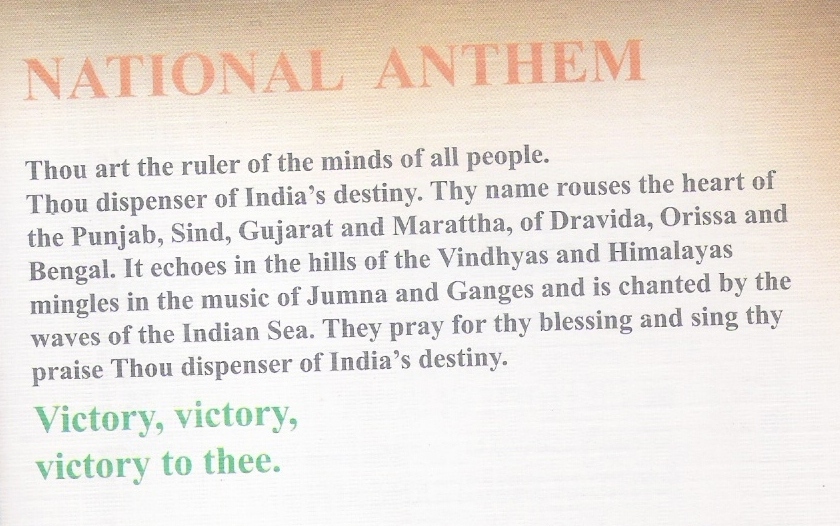
Indian National Anthem
Bangladesh National Anthem;
  Amar sonar Bangla,
Ami tomae bhalobashi.
           
My Bengal of Gold,
I love you.

Chirodin tomar akash,
Tomar batash,
Amar prane bajae bãshi.
           
Forever your skies,
Your air set my heart in tune
As if it were a flute.

O ma,
Phagune tor amer bone
Ghrane pagol kôre,
Mori hae, hae re,
O ma,
Ôghrane tor bhôra khete
Ami ki dekhechhi modhur hashi.
           
In spring, O mother mine,
The fragrance from your mango groves
Makes me wild with joy,
Ah, what a thrill!
In autumn, O mother mine,
In the full blossomed paddy fields
I have seen spread all over sweet smiles.

Ki shobha, ki chhaea go,
Ki sneho, ki maea go,
Ki ãchol bichhaeechho
Bôt,er mule,
Nodir kule kule!
          
Ah, what beauty, what shades,

What an affection, and what tenderness!

What a quilt have you spread

At the feet of banyan trees

And along the banks of rivers!


Ma, tor mukher bani

Amar kane lage,

Shudhar môto,

Mori hae, hae re,

Ma, tor bôdonkhani molin hole,

Ami nôeon jôle bhashi.


O mother mine, words from your lips

Are like nectar to my ears.

Ah, what a thrill!

If sadness, O mother mine,

Casts a gloom on your face,

My eyes are filled with tears!

Sri Lankan National Anthem

"Sri Lanka Matha" is the national anthem of Sri Lanka. The words and music were written by Ananda Samarakoon in 1940 in the Sinhala language, and was officially adopted as the national anthem on November 22, 1951 by a committee headed by Sir Edwin Wijeyeratne.The first line of the anthem originally read: "Namo namo matha, apa Sri Lanka". There was some controversy over these words in the 1950s, and in early 1962 they were changed to their present form.

Ananda Samarakoon was born George Wilfred Alwis to a Christian family in Padukka, in Ceylon, on January 13, 1911. 
 In 1936, Samarakoon left for Santiniketan in India to study art and music. After six months he abandoned his studies and returned to Sri Lanka, and changed his name to Ananda Samarakoon, embracing Buddhism. He was very much influenced by Rabindranath Tagore while in India and his fascination and the desire to imitate the great Indian musician would go on to take him in the direction of creating a musical tradition for the Sri Lankan people. During Samarakoon's stay in India, one of his early compositions, Namo Namo Mata (composed in 1940, recorded in 1946) was nominated as the national anthem and was officially adopted by the State as the Sri Lankan national anthem in 1952. Critics attacked Namo Namo Mata, particularly the "Gana" significance of the introductory words (Namo Namo Matha) which designate disease and ill luck. Samarakoon was not a believer in "Gana", and the criticism caused him to write numerous articles counter attacking his critics to defend his composition. However, without his consent, the introductory words were changed to "Sri Lanka Mathaa" so that the "Gana" significance now would designate victory and prosperity.

Sri Lanka Matha, apa Sri Lanka,                                                                                                            
    Namo Namo Namo Namo Matha.                                                                                                                                                                                  Sundara siri barini,
Surendi athi Sobamana Lanka
Dhanya dhanaya neka mal pala thuru piri, Jaya bhoomiya ramya.
Apa hata sapa siri setha sadana, jeewanaye Matha!
Piliganu mena apa bhakthi pooja,
Namo Namo Matha.
Apa Sri Lanka,
Namo Namo Namo Namo Matha
Obawe apa widya, Obamaya apa sathya
Obawe apa shakti, Apa hada thula bhakthi
Oba apa aloke, Aapage anuprane
oba apa jeewana we, Apa muktiya obawe
Nawa jeewana demine
Nnithina apa Pubudu karan matha
Gnana weerya wadawamina ragena yanu
mena jaya bhoomi kara
Eka mawekuge daru kala bawina
yamu yamu wee nopama
Namo Namo Matha
Apa Sri Lanka,
Namo Namo Namo Namo Matha.
 Translated
Mother Lanka we salute Thee!
Plenteous in prosperity, Thou,
Beauteous in grace and love,
Laden with grain and luscious fruit,
And fragrant flowers of radiant hue,
Giver of life and all good things,
Our land of joy and victory,
Receive our grateful praise sublime,
Lanka! we worship Thee.
Thou gavest us Knowledge and Truth,
Thou art our strength and inward faith,
Our light divine and sentient being,
Breath of life and liberation.
Grant us, bondage free, inspiration.
Inspire us for ever.
In wisdom and strength renewed,
Ill-will, hatred, strife all ended, In love enfolded, a mighty nation
Marching onward, all as one,
       Lead us, Mother, to fullest freedom.
In 1945 Samarakoon's only son died at the age of five and the grieving Samarakoon left Sri Lanka for India where he pursued a painting career and held eleven art exhibitions there. Though his painting were critically acclaimed, he returned to music in 1951 back in Sri Lanka. On April 5, 1962, at the age of fifty one, Samarakoon committed suicide. 

******************